

Many organisations recognise that tourism must evolve. What is far less clear is how to organise that change across governance, community relationships, experience development, evaluation, and training. Without clear operational structures, regenerative ambition risks remaining conceptual expressed in strategies, but fragmented in delivery. This practical section of Introducing Regenerative Tourism: Principles and Practices guide addresses that gap by sharing examples from Mediterranean territories and European cooperation projects. Instead of prescribing a single operational model, it presents concrete experiences that illustrate how different actors have taken steps toward regenerative tourism in diverse contexts. These cases serve as a source of inspiration and learning, highlighting multiple ways regeneration can be supported through governance, programme structures, learning processes, and real-world practice, while acknowledging that each place requires its own tailored approach. This practice section builds on the strategic foundations introduced in our article “What if the problem is no longer how well tourism is managed…” , which explains why regenerative tourism requires a shift in purpose, systems thinking, and community roles. If you have not yet read it, this article provides useful context for understanding how the following implementation elements fit together.
The practice model brings together four mutually reinforcing elements which together strengthen implementation capacity:
- Integrated governance model
Regenerative tourism requires inclusive, bottom-up governance involving public authorities, businesses, civil society, research, residents, visitors, and environmental actors. A dedicated governance approach supports coherence and shared ownership.
- Regeneration Tourism Programme
A structured process enables communities to express their values, priorities and feedback, supporting local learning and adaptive development.
- Evaluation of regeneration process
The Regenerative Tourism Journey tool supports reflection on regenerative progress, recognising qualitative dimensions alongside conventional indicators.
- Training on regeneration
Training builds shared understanding and capability, especially among stakeholders unfamiliar with regenerative approaches.

Why regenerative tourism matters in practice
The practice section frames regeneration as a response to places where caring capacity has been exceeded or eroded. It highlights benefits for ecosystems, communities, and tourism providers, including biodiversity protection, cultural revitalisation, strengthened local identity, and more distinctive experience positioning. Economic viability is reframed toward value retention, diversified income, and resilience rather than volume dependency.
Regenerative governance and community engagement in practice
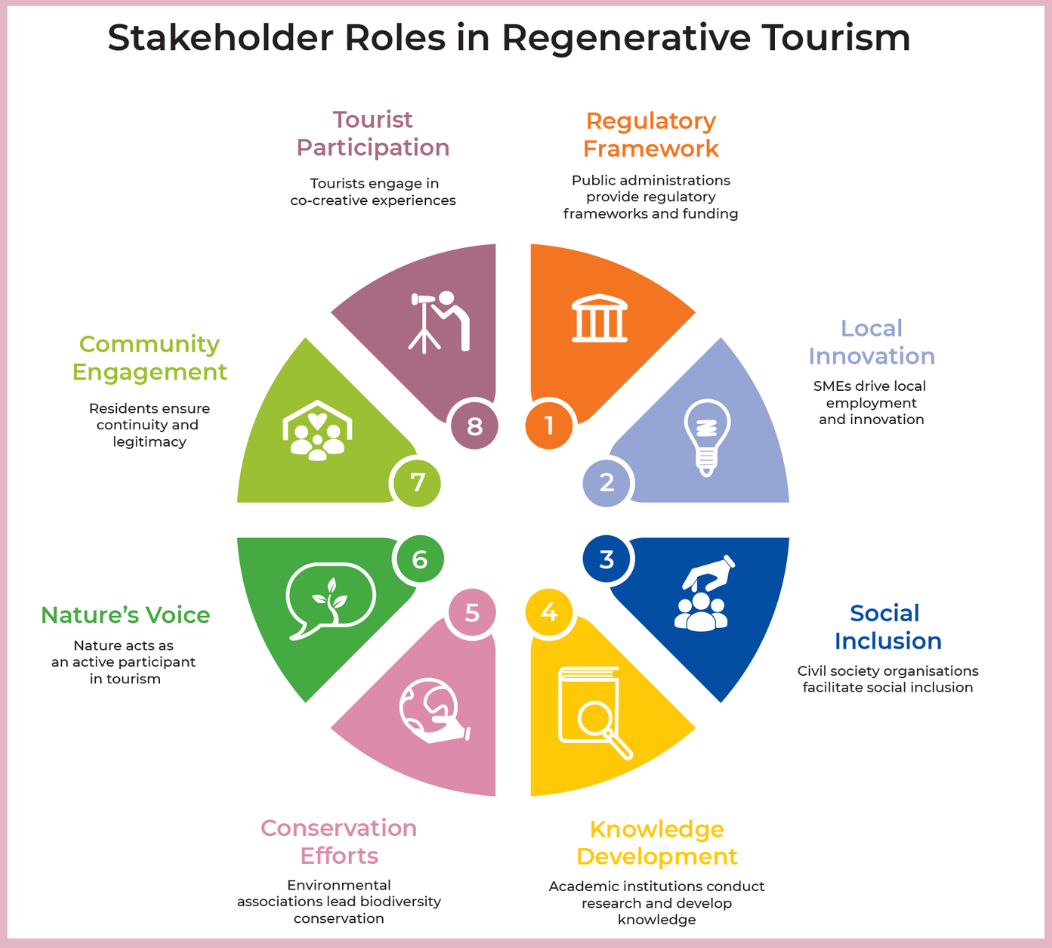
The Integrated Governance Model applies an 8-Helix stakeholder architecture that embeds collaboration across public, private, civil, academic, resident, visitor, and ecological dimensions. Community engagement is illustrated through the Islander Way example, showing engagement as an ongoing relationship rather than episodic consultation. Trust, dialogue, wellbeing orientation, and shared ownership are central. These governance dynamics can reduce friction, increase legitimacy, and improve alignment across sectors.
From experiences to regeneration journeys
Experiences are framed as entry points rather than endpoints. Designed intentionally, they catalyse awareness, connection, and learning. Place-based co-creation, hands-on engagement, storytelling, and respect for ecological rhythms support deeper visitor participation and local value creation. This can reduce commodification risk and strengthen differentiation.
Learning through real-world examples
This part of the report presents diverse initiatives across the Mediterranean and beyond, illustrating how regenerative intent/mindset translates into governance practices, community leadership, ecological stewardship, and transformative experiences. These examples demonstrate multiple pathways rather than a single template.
Why engaging with regenerative practice matters
Without structured implementation, regenerative ambition risks remaining rhetorical while underlying systems remain unchanged. Applied consistently, the framework supports:
- stronger coordination and governance quality,
- more credible community engagement,
- higher-quality project design and funding readiness,
- differentiated experience development,
- continuous learning and adaptive capacity,
- reduced exposure to operational and reputational risk.